
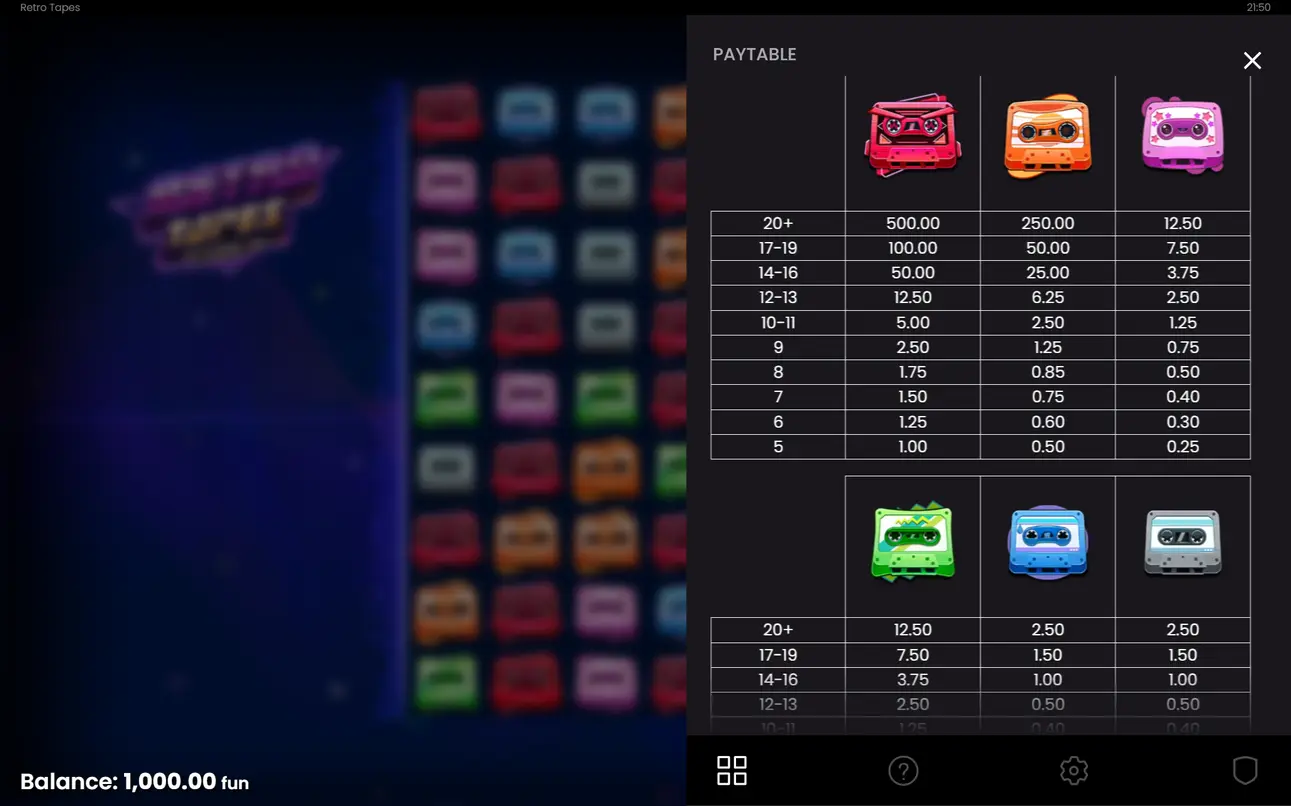
Paytable & Symbols
Retro Tapes Symbols and Paytable Explained
Every cassette, wild and multiplier in Retro Tapes, explained one by one.
- Max win
- 10000x
- Number of reels
- 6x9 grid
- Payline count
- Cluster pays / Cluster Link
- Return to player
- 96.47%
- Volatility rating
- High
Retro Tapes has no wild card ranks or fruit symbols. All wins come from six cassette-tape colours plus special icons: Wild Tape, Wild Multiplier star, Instant Prize coins and a Magnet symbol. Red tapes are the top standard payer, and the game's biggest single-symbol result comes from Instant Prize coin clusters carrying up to 1,000x.
- Grey and blue tapes pay least; red pays most among cassette colours
- Wild Tapes stick to the grid and gain +1x each time they help a cluster win
- Instant Prize coins pay directly when 5+ connect, values from 1x up to 1,000x
Reading the cassette hierarchy
Retro Tapes drops the usual card-suit filler entirely and builds its whole paytable around six cassette colours. The ranking runs grey and blue at the bottom, green and pink in the middle tier, orange as a clear high-payer, and red sitting alone at the top. Cluster size drives the payout within each colour, with values climbing steadily from the minimum 5-symbol cluster up through 20-plus connected tapes.
Red is where the paytable makes its statement. A cluster of 20 or more red tapes returns 1,000x the stake in one hit, and reviewers consistently single this position out as the game's headline standard-symbol payout. Orange sits a clear step below, still meaningfully ahead of the green and pink tier, which in turn separates itself from the grey and blue base symbols by a comfortable margin at large cluster sizes.
The Wild Tape changes how the whole grid behaves rather than just substituting for missing symbols. Shown as a rainbow-coloured cassette, it fills in for any paying colour, but its real function is persistence: once it lands and contributes to a cluster win, it stays on the grid through the following cascade instead of clearing away, and its built-in multiplier rises by 1x each time it does so. A base game spin that chains several cascades can end up with two or three Wild Tapes sitting at increasingly high multipliers, each one boosting whatever cluster it later joins.
The Wild Multiplier star works as a support piece rather than a payer in its own right. When it appears, its value — 1x, 2x, 3x or 5x depending on the draw — is added to every visible Wild Tape on the grid at that moment. Having done its job, the star converts into an Instant Prize coin, so it never simply vanishes; it hands off into the coin economy that drives the game's largest wins.
Instant Prize coins are the symbol most directly tied to Retro Tapes' 10,000x ceiling. Their values span 1x, 2x, 5x, 10x, 25x, 50x, 100x, 250x, 500x and 1,000x, and a cluster of five or more connected coins pays out the sum of those values, with any adjacent Wild Tape multipliers applied on top. The Magnet symbol supports this system by pulling matching tapes or coins toward itself before converting into a paying symbol of random value, which is one reason coin clusters can form even when the grid initially looks scattered.
Because there are no fixed paylines, cluster connectivity — horizontal or vertical, never diagonal — decides every win. Combined with sticky, multiplying wilds and a coin-based bonus economy layered on top of the standard cassette paytable, Retro Tapes reads less like a conventional symbol list and more like a small interacting system, where the Magnet and Wild Multiplier exist specifically to feed the coin cluster mechanic that produces the game's biggest results.
Estimating cluster and coin payouts
Maximum win – C$
Figures below model the paytable's theoretical structure — the published 1,000x red-tape cluster and the 10,000x overall ceiling reachable through combined coin and wild-multiplier stacking. These are mathematical extremes, not typical spin outcomes, and actual returns on any given session will sit far below them the vast majority of the time.
How the special symbols interact
None of Retro Tapes' special symbols work in isolation. The Wild Tape's growing multiplier only matters because it survives cascades rather than clearing after one win, which lets its value compound across a chain of connected clusters. The Wild Multiplier star exists purely to accelerate that compounding, feeding its value into every wild currently on the grid before it hands itself off as an Instant Prize coin. The Magnet symbol then acts as connective tissue for the coin economy, dragging scattered coins and matching tapes together so that a five-coin cluster becomes achievable rather than a rare accident. Read together, the four special symbols form a single escalation path: wilds accumulate multiplier value, the star injects extra multiplier and converts to currency, the magnet assembles that currency into paying clusters, and the coin paytable converts the assembled cluster into the stake multiple actually credited to the player.
Retro Tapes release timeline
Retro Tapes launches from Push Gaming (23 November 2022 per third-party sources), introducing the Cluster Link mechanic with cassette-themed symbols on a 6x9 grid.
Paytable questions players ask
Why does a red cassette cluster pay so much more than green or pink at the same size?
Red sits at the top of the standard cassette hierarchy by design; a 20+ cluster of red tapes returns 1,000x stake, well above the mid-tier green and pink symbols at equivalent cluster sizes, marking it as the paytable's flagship non-coin position.
Does the Wild Tape reset its multiplier after a cascade?
No. Once a Wild Tape contributes to a winning cluster it remains on the grid rather than clearing, and its multiplier increases by 1x each additional time it helps form a win, so its value can keep climbing through a cascade chain.
What happens to the Wild Multiplier star after it lands?
It applies its multiplier value to every visible Wild Tape symbol on the grid at that moment, then converts into an Instant Prize coin, effectively becoming a paying symbol for the next cluster evaluation.
How many Instant Prize coins are needed to trigger a payout?
A cluster of five or more connected coins is required. The values summed range from 1x up to 1,000x per coin, and any active Wild Tape multiplier can add to the total before it's paid.
What does the Magnet symbol actually do on the grid?
It draws matching cassette tapes or Instant Prize coins toward its position, helping form or enlarge a cluster, and once its effect resolves it converts into a paying cassette symbol or a random-value coin itself.
Can a cluster win form diagonally on the grid?
No. Clusters only connect horizontally or vertically between adjacent matching symbols; diagonal adjacency does not count toward a winning cluster in Retro Tapes.
Is there a dedicated scatter symbol separate from the wild?
Not in the traditional sense. There's no distinct scatter icon; the Wild Tape and its clustering behaviour are tied into how the bonus round is approached, rather than a separate free-spins-triggering symbol.
Why do grey and blue tapes pay so little even at large cluster sizes?
They occupy the lowest paytable tier by design, intended as filler symbols that appear more frequently; their payout curve rises with cluster size but stays well below the green/pink and orange/red tiers even at 20+ connections.